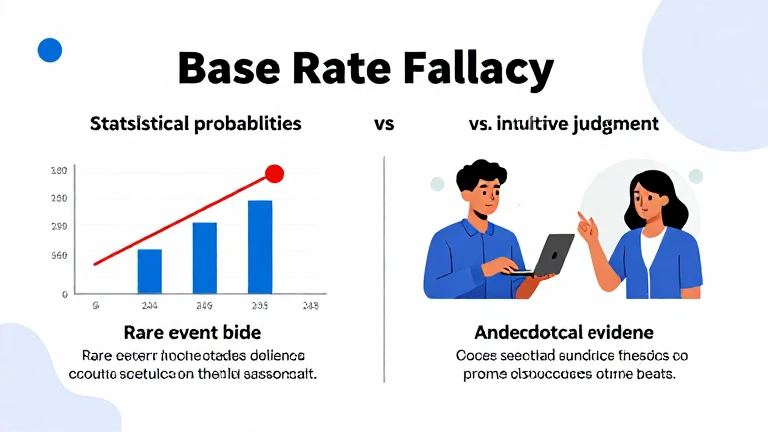
Base Rate Fallacy investment psychology concept
In everyday reasoning and decision-making, people often rely on specific details or intuitive impressions rather than statistical information. One cognitive bias that illustrates this tendency is the Base Rate Fallacy.
The Base Rate Fallacy occurs when individuals ignore or misunderstand general statistical probabilities (base rates) while making judgments about specific situations. As a result, people may reach conclusions that seem logical but are statistically inaccurate.
1. What Is the Base Rate Fallacy?
The Base Rate Fallacy refers to the error of failing to properly consider the overall probability of an event when evaluating new information.
A base rate represents the general frequency or probability of something occurring within a larger population. When this statistical context is ignored, people may give too much weight to individual descriptions or recent observations.
This can lead to conclusions that feel convincing but are mathematically unlikely.
2. A Simple Example

Medical test base rate illustration
Consider a medical test designed to detect a rare disease.
- The disease affects 1% of the population.
- The test is 90% accurate.
Without considering the base rate, it is easy to misinterpret a positive test result.
3. Base Rate Fallacy in Investing
This bias frequently appears in financial markets, where investors often focus on exceptional cases rather than statistical patterns.
- Startup Success Stories: Most startups fail in the first few years. Ignoring base rate leads to unrealistic expectations.
- Market Timing: Consistently predicting short-term market movements is extremely difficult. Base rate success is very low.
- Cryptocurrency Trends: Rapid gains are rare; many assets eventually lose value.
4. Why the Base Rate Fallacy Happens
- Preference for Concrete Stories: Vivid narratives are more compelling than statistics.
- Overconfidence in Intuition: Intuition feels convincing even if wrong.
- Limited Statistical Thinking: Probability is often difficult to apply.
5. How to Avoid the Base Rate Fallacy
- Consider overall probabilities
- Look beyond individual examples
- Use data-driven analysis
- Be cautious with rare events
Understanding the base rate helps make more rational decisions in finance, health, and daily life.
Category
Finance / Investment | Behavioral Psychology
Tags
#InvestmentPsychology
#BehavioralFinance
#BaseRateFallacy
#StockMarketPsychology
#InvestorMindset
#CommonInvestingMistakes
#TradingPsychology
#CognitiveBias
#FinancialBehavior
#DecisionMaking

