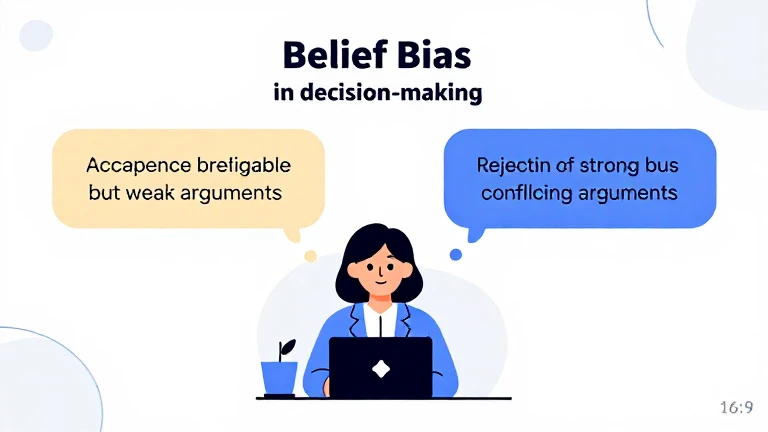
In decision-making and reasoning, people often believe they evaluate arguments objectively. However, personal beliefs can strongly influence how individuals interpret information. One psychological phenomenon that demonstrates this tendency is Belief Bias.
Belief Bias occurs when people judge the strength of an argument based on whether they agree with its conclusion rather than whether the logic is valid. As a result, individuals may accept weak arguments if they align with their beliefs and reject strong arguments if they challenge them.
1. What Is Belief Bias?
Belief Bias refers to the tendency to allow personal beliefs or prior opinions to interfere with logical reasoning.
Instead of evaluating an argument purely based on its structure and evidence, people often rely on whether the conclusion feels believable or consistent with what they already think.
This bias can affect judgments in many areas, including politics, science, business, and everyday discussions.
2. Example of Belief Bias

Consider the following two arguments:
Argument A
- All successful entrepreneurs work extremely long hours.
- Alex works extremely long hours.
- Therefore, Alex is a successful entrepreneur.
Although the conclusion may seem believable, the logic is flawed because working long hours does not necessarily guarantee success.
Argument B
- All mammals can breathe air.
- Dolphins are mammals.
- Therefore, dolphins can breathe air.
This argument is logically valid. However, if someone does not believe the premises, they might reject the conclusion despite the logical structure.
Belief Bias occurs when people judge these arguments based on their beliefs instead of the logical reasoning involved.
3. Belief Bias in Investing
This bias frequently appears in financial decision-making.
- Strong Opinions About Certain Stocks: Investors may accept weak arguments supporting a stock they believe in, while dismissing strong evidence of risks.
- Market Narratives: Investors who believe a sector will grow may accept overly optimistic projections without careful evaluation.
- Cryptocurrency Communities: Online groups may reject valid criticism if it conflicts with belief in a project’s success.
4. Why Belief Bias Happens
- Cognitive Efficiency: Relying on existing beliefs takes less mental effort than analyzing arguments.
- Emotional Attachment: Beliefs connected to identity make challenging them uncomfortable.
- Selective Reasoning: People prefer information that confirms their worldview.
5. How to Reduce Belief Bias
- Evaluate logic separately from the conclusion: Focus on argument structure.
- Consider opposing viewpoints: Explore alternative perspectives.
- Rely on evidence and data: Objective info reduces bias influence.
- Practice critical thinking: Question assumptions regularly.
Conclusion
Belief Bias highlights how personal beliefs can influence reasoning. Even when people think they are objective, opinions shape evaluation.
By focusing on evidence, analyzing logical structures, and remaining open to different perspectives, individuals can make more rational and balanced judgments.
Category
Finance / Investment | Behavioral Psychology
Tags
#InvestmentPsychology
#BehavioralFinance
#BeliefBias
#LogicalReasoning
#CognitiveBias
#StockMarketPsychology
#InvestorMindset
#CriticalThinking
#DecisionMaking
#TradingPsychology


