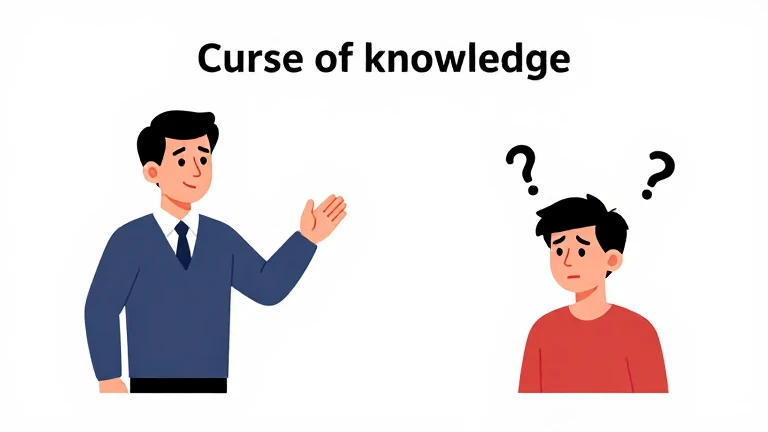
Knowledge is generally seen as an advantage. However, once people become familiar with a subject, it can become surprisingly difficult for them to imagine what it is like not to know that information. This cognitive bias is known as the Curse of Knowledge.
The Curse of Knowledge occurs when someone who understands a topic assumes that others have the same background knowledge, making explanations or communication less clear. As a result, experts may unintentionally use complex language or skip important details that beginners need.
1. What Is the Curse of Knowledge?
The Curse of Knowledge refers to the tendency for well-informed individuals to struggle when trying to explain concepts to people with less knowledge.
Once information becomes familiar, it is hard to mentally return to the perspective of someone encountering the idea for the first time.
This can lead to communication gaps in education, business, and technical fields.
2. A Classic Demonstration
A well-known experiment illustrating the Curse of Knowledge involves a simple game with two roles: “tappers” and “listeners.”
- The tapper taps the rhythm of a well-known song on a table.
- The listener tries to guess the song.
Tappers often expect listeners to recognize the tune easily because they can clearly hear the melody in their minds. However, listeners usually struggle to identify the song because they only hear random tapping sounds.
This experiment highlights how difficult it can be for knowledgeable individuals to imagine the perspective of someone without that knowledge.
3. Examples of the Curse of Knowledge

- Teaching and Education: Teachers may skip foundational explanations, assuming students understand basics.
- Business Communication: Professionals may use specialized terminology or jargon that confuses clients or colleagues.
- Technology and Product Design: Developers create products intuitive to them but difficult for beginners.
- Financial and Investment Advice: Experienced investors explain strategies with complex terms, assuming beginners understand concepts like diversification, volatility, or risk management.
4. Why the Curse of Knowledge Happens
- Mental Anchoring in Expertise: Knowledge becomes the default perspective.
- Difficulty Reconstructing Ignorance: People cannot easily recreate the mindset of someone who has never learned the information.
- Overestimation of Shared Knowledge: Experts assume concepts are more widely understood than they actually are.
5. How to Overcome the Curse of Knowledge
- Use simple explanations: Start with basic concepts before introducing complex ideas.
- Avoid unnecessary jargon: Plain language ensures understanding.
- Ask for feedback: Encouraging questions reveals misunderstandings.
- Use examples and analogies: Relating concepts to familiar experiences makes them easier to grasp.
Conclusion
The Curse of Knowledge shows how expertise can sometimes make communication more difficult rather than easier. When individuals assume that others share the same level of understanding, important explanations may be overlooked.
By simplifying language, providing context, and considering the audience’s perspective, people can communicate more effectively and clearly across different levels of knowledge.
Category
Behavioral Psychology | Communication
Tags
#CognitiveBias
#CurseOfKnowledge
#Education
#BusinessCommunication
#InvestorMindset
#CriticalThinking
#DecisionMaking
#BehavioralEconomics
#ExpertCommunication
#Learning
'Behavioral Finance' 카테고리의 다른 글
| Denomination Effect: How the Size of Money Units Influences Spending (0) | 2026.03.16 |
|---|---|
| Decoy Effect: How a Third Option Influences Our Choices (0) | 2026.03.15 |
| Contrast Effect: How Comparisons Influence Our Perception (0) | 2026.03.15 |
| Conservatism (Bayesian): Why People Update Beliefs Too Slowly (0) | 2026.03.14 |
| Conservatism Bias: Why People Are Slow to Update Their Beliefs (0) | 2026.03.14 |


