728x90
반응형

Human creativity is often limited by the way we perceive the function of objects. This cognitive bias is known as Functional Fixedness—the tendency to see things only in their usual role, making it difficult to use them in new ways.
1. What Is Functional Fixedness?
- People often fail to see alternative uses for familiar objects.
- This bias can reduce problem-solving ability, creativity, and innovation.
- It occurs in everyday life, education, work, and design thinking.
2. Why Functional Fixedness Happens
Several psychological mechanisms contribute:
- Mental Set: Previous experience teaches us the “normal” use of objects.
- Cognitive Efficiency: It’s easier to rely on learned uses than explore new ones.
- Perception Limitation: Focusing on standard functions blinds us to novel applications.
- Problem Framing: If a problem is presented in a familiar context, unusual solutions may be overlooked.
3. Classic Example
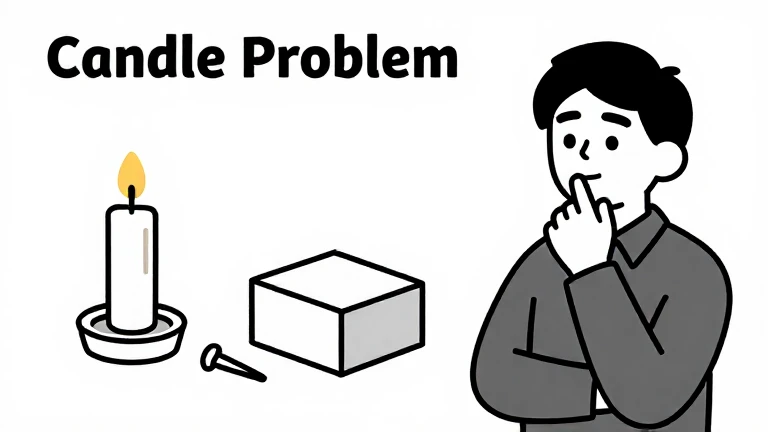
- The Candle Problem (Duncker, 1945):
Participants are asked to attach a candle to a wall using a box of tacks. Many struggle because they see the box only as a container rather than a potential support for the candle.
The solution requires reimagining the box as a platform, not just a container.
4. Everyday Examples of Functional Fixedness
- Using a hammer only to hit nails, not realizing it can open bottles or serve as a weight.
- Viewing a paperclip only as a fastener, ignoring its potential as a hook or tool.
- Treating a chair only for sitting, missing opportunities for it as a step stool.
- In software, seeing a feature only in its original use instead of adapting it for new workflows.
5. Risks of Functional Fixedness
- Reduced Creativity: Sticking to standard uses limits innovation.
- Problem-Solving Delays: Difficulty finding unconventional solutions slows progress.
- Inefficient Resource Use: Objects and tools may be underutilized.
- Missed Opportunities: Alternative approaches are ignored.
6. How to Overcome Functional Fixedness
- Reframe the Problem: Ask, “What else could this object do?”
- Encourage Divergent Thinking: Brainstorm multiple uses, even unusual ones.
- Challenge Assumptions: Actively question standard uses.
- Experiment: Hands-on manipulation can reveal alternative functions.
- Learn from Analogies: Study how others repurpose tools and objects creatively.
Conclusion
Functional Fixedness demonstrates how our minds can limit creativity by focusing on conventional uses. By consciously considering alternative functions, experimenting, and reframing problems, individuals can unlock innovative solutions and enhance problem-solving skills.
Category
Cognitive Bias | Creativity
Tags
#FunctionalFixedness
#CognitiveBias
#ProblemSolving
#CreativeThinking
#Innovation
#BehavioralScience
반응형
'Behavioral Finance' 카테고리의 다른 글
| Spotlight Effect: Why We Think Everyone Is Watching Us (0) | 2026.03.19 |
|---|---|
| Focusing Effect: Why We Overemphasize One Aspect of Life (0) | 2026.03.19 |
| False Consensus Effect: Why We Overestimate How Much Others Agree with Us (0) | 2026.03.18 |
| Experimenter / Expectation Bias: How Our Expectations Shape Outcomes (0) | 2026.03.18 |
| Exaggerated Expectations: When We Overestimate Outcomes (0) | 2026.03.17 |


