
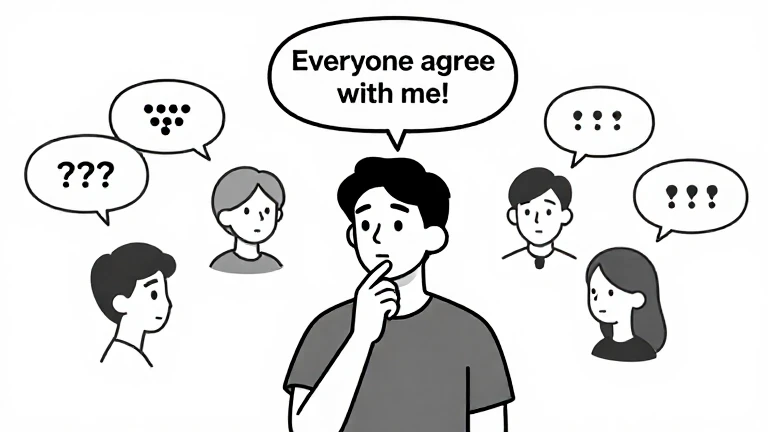
Humans naturally assume that their opinions, beliefs, and behaviors are “normal” or widely shared. This tendency is called the False Consensus Effect—the cognitive bias where people overestimate the extent to which others agree with them.
1. What Is the False Consensus Effect?
- People tend to assume their own views are common, even when evidence suggests otherwise.
- This bias helps individuals feel validated, reduces uncertainty, and reinforces social belonging.
- However, it can distort judgment, social perception, and decision-making.
2. Why the False Consensus Effect Happens
Several psychological mechanisms contribute:
- Projection: People assume others think and act like they do.
- Self-Enhancement: Believing that one’s own choices are popular boosts confidence.
- Social Exposure: Interacting mostly with like-minded individuals reinforces the illusion of consensus.
- Cognitive Ease: It is mentally simpler to assume agreement than to evaluate diverse perspectives.
3. Examples of the False Consensus Effect
- Everyday Opinions: Believing everyone prefers your favorite movie, food, or political view.
- Workplace Behavior: Assuming coworkers share the same approach to tasks, deadlines, or ethics.
- Health & Lifestyle: Thinking everyone avoids certain habits (like smoking) when in reality many don’t.
- Financial Decisions: Investors may assume that other traders share their strategies or risk tolerance.
4. Risks of the False Consensus Effect
- Overconfidence: Decisions may be made based on perceived agreement that doesn’t exist.
- Social Misjudgment: Misreading group opinion can cause conflict or social friction.
- Poor Planning: Business, policy, or marketing strategies may fail if consensus is assumed incorrectly.
- Confirmation Bias Reinforcement: Believing “everyone thinks like me” encourages selective attention to supporting evidence.
5. How to Reduce the False Consensus Effect
- Seek Diverse Perspectives: Actively engage with people holding different opinions.
- Gather Data: Base decisions on surveys, feedback, or objective metrics rather than intuition.
- Question Assumptions: Ask, “Is it likely that others actually share this view?”
- Awareness: Simply knowing about this bias helps reduce its influence.
- Consider Minority Opinions: Give weight to differing perspectives to counteract the illusion of agreement.
Conclusion
The False Consensus Effect shows how people often overestimate agreement with their own beliefs. While it provides comfort and validation, it can also mislead judgment, distort social perception, and lead to flawed decisions.
By actively seeking diverse viewpoints, questioning assumptions, and using objective evidence, individuals can overcome this bias and make more balanced, realistic decisions.
Category
Cognitive Bias | Social Psychology
Tags
#FalseConsensusEffect
#ConsensusBias
#CognitiveBias
#SocialPsychology
#DecisionMaking
#BehavioralScience
#ObserverBias
'Behavioral Finance' 카테고리의 다른 글
| Focusing Effect: Why We Overemphasize One Aspect of Life (0) | 2026.03.19 |
|---|---|
| Functional Fixedness: How We Limit Ourselves by Seeing Objects Only One Way (0) | 2026.03.18 |
| Experimenter / Expectation Bias: How Our Expectations Shape Outcomes (0) | 2026.03.18 |
| Exaggerated Expectations: When We Overestimate Outcomes (0) | 2026.03.17 |
| Essentialism: Why We Assume Things Have an “Essence” (0) | 2026.03.17 |


