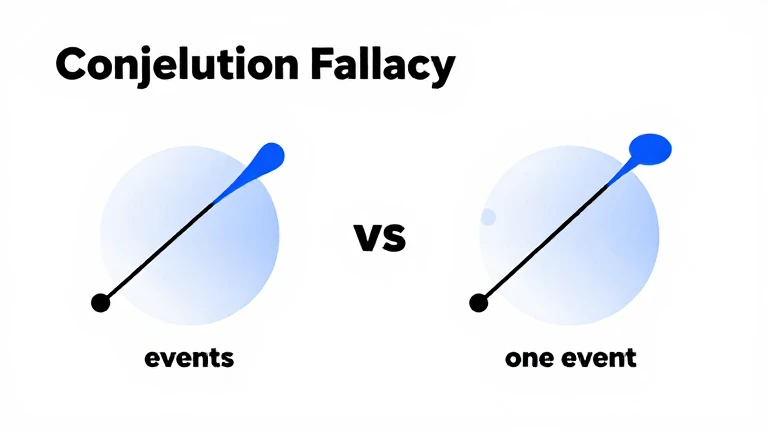
Human reasoning often relies on intuition, but intuition can sometimes lead to logical mistakes. One well-known cognitive bias that demonstrates this is the Conjunction Fallacy.
The Conjunction Fallacy occurs when people believe that a combination of events is more likely than a single general event. Statistically, this is impossible because the probability of two events occurring together cannot be higher than the probability of one of those events occurring alone.
1. What Is the Conjunction Fallacy?
The Conjunction Fallacy refers to the error of assuming that a detailed scenario involving multiple conditions is more probable than a simpler scenario involving fewer conditions.
In probability theory, the likelihood of two events occurring together (a conjunction) must always be equal to or lower than the probability of either event occurring individually.
However, when a combined story feels more realistic or representative, people may mistakenly judge it as more likely.
2. The Famous “Linda Problem”

A classic example describes a fictional person named Linda:
- Intelligent, socially conscious, concerned with justice and equality.
Participants are asked which statement is more likely:
- Linda is a bank teller.
- Linda is a bank teller and active in the feminist movement.
Many people choose the second option because it seems to fit their mental image. However, logically, the second option is less likely because it contains two conditions instead of one.
This example was introduced by Daniel Kahneman and Amos Tversky to show how intuition can conflict with probability rules.
3. Why the Conjunction Fallacy Happens
- Representativeness Heuristic: Judging probability based on resemblance to mental image or stereotype.
- Narrative Appeal: Detailed stories feel more believable than simple statements.
- Intuitive Thinking: Focus on plausibility rather than statistical logic.
4. Conjunction Fallacy in Real Life
- Media Narratives: News stories combine multiple details that seem convincing but are statistically less probable.
- Investing and Market Predictions: Investors may believe complex predictions, e.g., “a tech company will launch a revolutionary product and dominate the market.” Each additional condition lowers probability.
- Risk Assessment: People often focus on elaborate scenarios, ignoring simpler, more probable outcomes.
5. How to Avoid the Conjunction Fallacy
- Focus on basic probability rules: Adding conditions lowers overall probability.
- Separate plausibility from likelihood: Convincing stories may still be unlikely.
- Break complex predictions into parts: Evaluate each condition individually.
- Use quantitative analysis: Data-driven evaluation reduces intuitive mistakes.
Conclusion
The Conjunction Fallacy shows how believable stories can mislead statistical reasoning. When scenarios include more details that match expectations, they feel realistic even though they are mathematically less likely.
By recognizing this bias, individuals can improve probability judgment, clear reasoning, and more rational decision-making.
Category
Finance / Investment | Behavioral Psychology
Tags
#InvestmentPsychology
#BehavioralFinance
#ConjunctionFallacy
#CognitiveBias
#ProbabilityMistakes
#DecisionMaking
#InvestorMindset
#CriticalThinking
#RiskAssessment
#StatisticalThinking
'Behavioral Finance' 카테고리의 다른 글
| Conservatism (Bayesian): Why People Update Beliefs Too Slowly (0) | 2026.03.14 |
|---|---|
| Conservatism Bias: Why People Are Slow to Update Their Beliefs (0) | 2026.03.14 |
| Congruence Bias: Why We Test Ideas in Ways That Confirm Them (0) | 2026.03.13 |
| Confirmation Bias: Why We Prefer Information That Supports Our Beliefs (0) | 2026.03.13 |
| Clustering Illusion: Seeing Patterns in Random Events (0) | 2026.03.13 |


