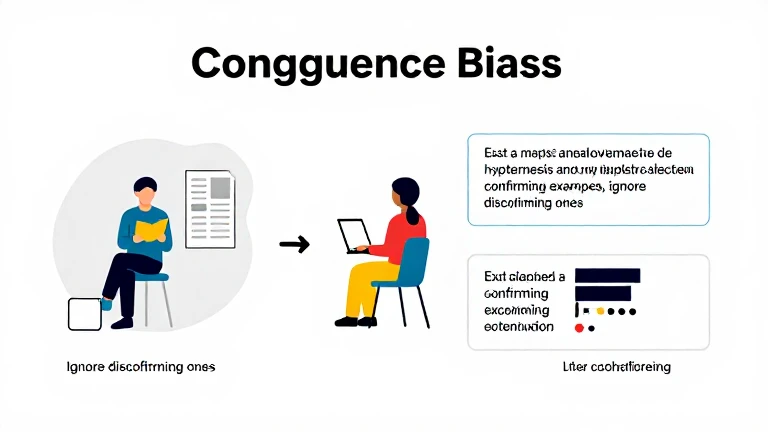
When people form a hypothesis or belief, they often try to test whether it is correct. However, the way individuals test their ideas is not always objective. Congruence Bias explains why people frequently search for evidence that supports their assumptions rather than evidence that could disprove them.
Congruence Bias refers to the tendency to test a hypothesis by looking for examples that confirm it instead of actively trying to challenge or falsify it. This bias can lead to incomplete reasoning and incorrect conclusions.
1. What Is Congruence Bias?
Congruence Bias occurs when individuals focus on confirming their existing ideas rather than exploring alternative possibilities.
Instead of asking, “What evidence might prove this wrong?” people tend to ask, “What evidence would show this is correct?” This approach may sometimes work but often fails to reveal flaws in reasoning.
As a result, people may remain confident in incorrect beliefs simply because they did not test them thoroughly.
2. A Classic Example of Congruence Bias
One well-known demonstration involves number sequences:
- Participants are given a sequence like 2–4–6 and asked to determine the rule.
- Many guess “increasing by two” and test sequences like 8–10–12 or 20–22–24, which fit their hypothesis.
- The actual rule may simply be any increasing sequence of numbers.
Because participants only test examples that confirm their assumption, they fail to discover the broader rule.
3. Congruence Bias in Everyday Life
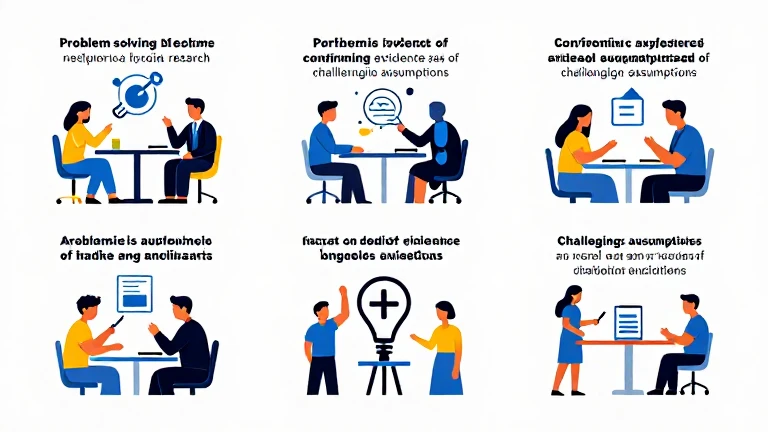
- Problem Solving: People stick to strategies aligned with initial assumptions, ignoring better alternatives.
- Scientific Reasoning: Experiments must be designed to potentially disprove hypotheses; otherwise, Congruence Bias can mislead interpretation.
- Investing and Business Decisions: Investors may search for data supporting their favored stock while overlooking risks or negative signals.
4. Risks of Congruence Bias
- Incomplete Testing of Ideas: Hypotheses may appear correct simply because they were not challenged.
- Overconfidence in Assumptions: Repeated confirmation can create a false sense of certainty.
- Missed Alternatives: Better explanations or solutions may be overlooked.
5. How to Reduce Congruence Bias
- Search for disconfirming evidence: Ask what evidence might prove a hypothesis wrong.
- Consider alternative explanations: Explore multiple possibilities to avoid narrow thinking.
- Use structured testing methods: Scientific and statistical approaches encourage objective analysis.
- Encourage critical feedback: Other perspectives can reveal weaknesses in assumptions.
Conclusion
Congruence Bias shows how people often test their beliefs in ways that confirm them rather than challenge them. While this approach can make reasoning feel efficient, it may prevent individuals from discovering more accurate explanations.
By actively seeking evidence that could disprove assumptions, individuals can develop stronger critical thinking and more reliable decision-making skills.
Category
Finance / Investment | Behavioral Psychology
Tags
#InvestmentPsychology
#BehavioralFinance
#CongruenceBias
#CognitiveBias
#CriticalThinking
#ProblemSolving
#DecisionMaking
#ScientificReasoning
#InvestorMindset
#BiasAwareness
'Behavioral Finance' 카테고리의 다른 글
| Conservatism Bias: Why People Are Slow to Update Their Beliefs (0) | 2026.03.14 |
|---|---|
| Conjunction Fallacy: When More Specific Stories Seem More Likely (0) | 2026.03.14 |
| Confirmation Bias: Why We Prefer Information That Supports Our Beliefs (0) | 2026.03.13 |
| Clustering Illusion: Seeing Patterns in Random Events (0) | 2026.03.13 |
| Choice-Supportive Bias: Why We Defend Our Past Decisions (0) | 2026.03.12 |


