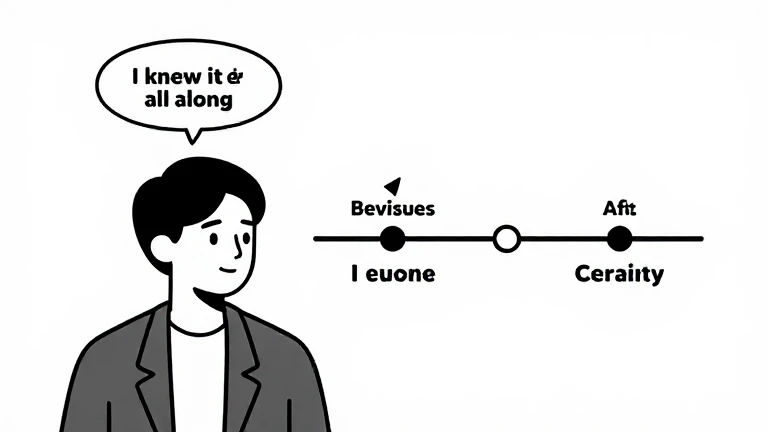
After an event occurs, people often feel that the outcome was predictable all along. This tendency is known as Hindsight Bias.
Hindsight Bias refers to the tendency to see events as more predictable after they have already happened, even if there was little certainty beforehand.
1. What Is Hindsight Bias?
- After knowing the outcome, people believe they “knew it all along.”
- Past uncertainty is underestimated or forgotten.
- Outcomes appear more obvious in retrospect than they actually were.
2. How It Works
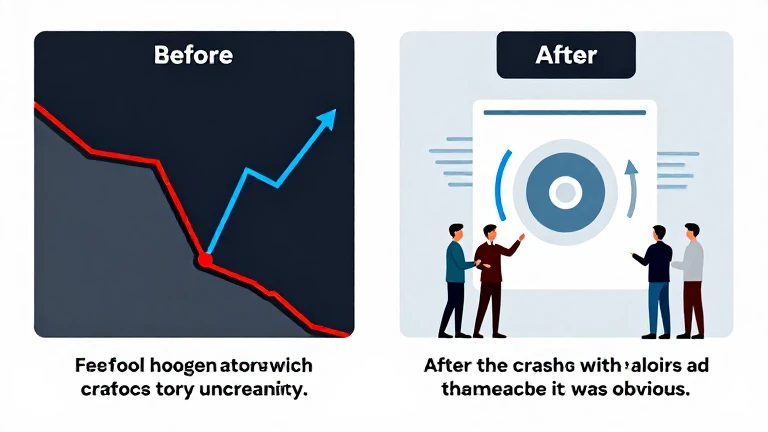
- Before an event: multiple outcomes seem possible.
- After the event: the actual result feels inevitable.
- Memory is reconstructed to align with the known outcome.
3. Examples of Hindsight Bias
- Investing:
After a market crash, people say, “It was obvious the market would fall.” - Sports:
Fans claim they knew which team would win after the game ends. - Business Decisions:
Failed projects are judged as predictable mistakes in hindsight. - Everyday Life:
People believe they predicted outcomes that they actually did not foresee.
4. Why Hindsight Bias Happens
Several psychological mechanisms contribute:
- Memory Reconstruction: Memories are adjusted to fit outcomes.
- Need for Certainty: People prefer believing the world is predictable.
- Cognitive Simplification: The brain simplifies complex past uncertainty.
- Self-Enhancement: Believing “I knew it” boosts confidence.
5. Risks of Hindsight Bias
- Overconfidence: Believing you can predict future events more accurately.
- Poor Learning: Ignoring the true uncertainty of past decisions.
- Unfair Judgments: Criticizing decisions without considering context.
- Repeated Mistakes: Failing to understand why outcomes actually occurred.
6. How to Reduce Hindsight Bias
- Record Predictions: Write down expectations before outcomes occur.
- Review Past Thinking: Compare actual predictions with results.
- Acknowledge Uncertainty: Accept that multiple outcomes were possible.
- Focus on Process: Evaluate decisions based on reasoning, not results.
- Use Data: Rely on evidence rather than reconstructed memory.
Conclusion
Hindsight Bias shows how easily people rewrite the past to make it seem predictable. While outcomes may appear obvious after the fact, they were often uncertain beforehand.
By recognizing this bias and focusing on decision processes rather than results, individuals can improve judgment and make better future decisions.
Category
Cognitive Bias | Behavioral Psychology
Tags
#HindsightBias
#CognitiveBias
#DecisionMaking
#Overconfidence
#BehavioralEconomics
#Psychology
#Investing


