728x90
반응형

Overconfidence Bias refers to the tendency for individuals to overestimate their knowledge, abilities, or the accuracy of their predictions.
1. What Is Overconfidence Bias?
- People believe they are more accurate, skilled, or informed than they actually are.
- This leads to overestimating success probabilities and underestimating risks.
- It is one of the most common and impactful cognitive biases.
2. Why It Happens
- Self-Enhancement: Desire to maintain a positive self-image.
- Illusion of Control: Belief that outcomes are more controllable than they are.
- Selective Memory: Remembering successes more than failures.
- Limited Feedback: Lack of accurate feedback reinforces confidence.
3. Examples of Overconfidence Bias
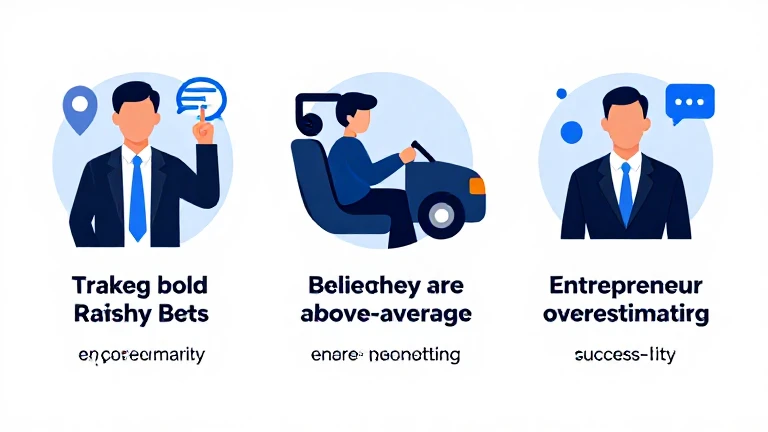
- Investing: Traders making large bets believing they can predict the market.
- Driving: Most people think they are better-than-average drivers.
- Business: Entrepreneurs overestimating the likelihood of success.
- Exams & Skills: People overestimating how well they will perform.
4. Risks of Overconfidence Bias
- Excessive Risk-Taking: Ignoring potential downsides.
- Poor Decision-Making: Acting on incomplete or inaccurate assumptions.
- Financial Losses: Overtrading or making aggressive investments.
- Failure to Learn: Dismissing mistakes or feedback.
5. How to Reduce Overconfidence Bias
- Seek Feedback: Listen to objective opinions and critiques.
- Use Data: Base decisions on evidence rather than intuition alone.
- Consider Alternatives: Actively look for reasons you might be wrong.
- Track Performance: Compare predictions with actual outcomes.
- Adopt Probabilistic Thinking: Think in terms of likelihoods, not certainties.
Conclusion
Overconfidence Bias shows how excessive belief in one’s abilities can distort judgment and increase risk. While confidence is valuable, too much of it can lead to costly mistakes.
By combining confidence with humility and data-driven thinking, individuals can make more balanced and effective decisions.
Category
Cognitive Bias | Decision-Making | Behavioral Economics
Tags
#OverconfidenceBias
#CognitiveBias
#DecisionMaking
#BehavioralEconomics
#RiskManagement
반응형
'Behavioral Finance' 카테고리의 다른 글
| Pessimism Bias: Expecting the Worst (0) | 2026.03.29 |
|---|---|
| Pareidolia: Seeing Meaning Where There Is None (0) | 2026.03.29 |
| Outcome Bias: Judging Decisions by Results (0) | 2026.03.28 |
| Optimism Bias: Why We Expect the Best (0) | 2026.03.27 |
| Omission Bias: Why Doing Nothing Feels Safer (0) | 2026.03.27 |


